
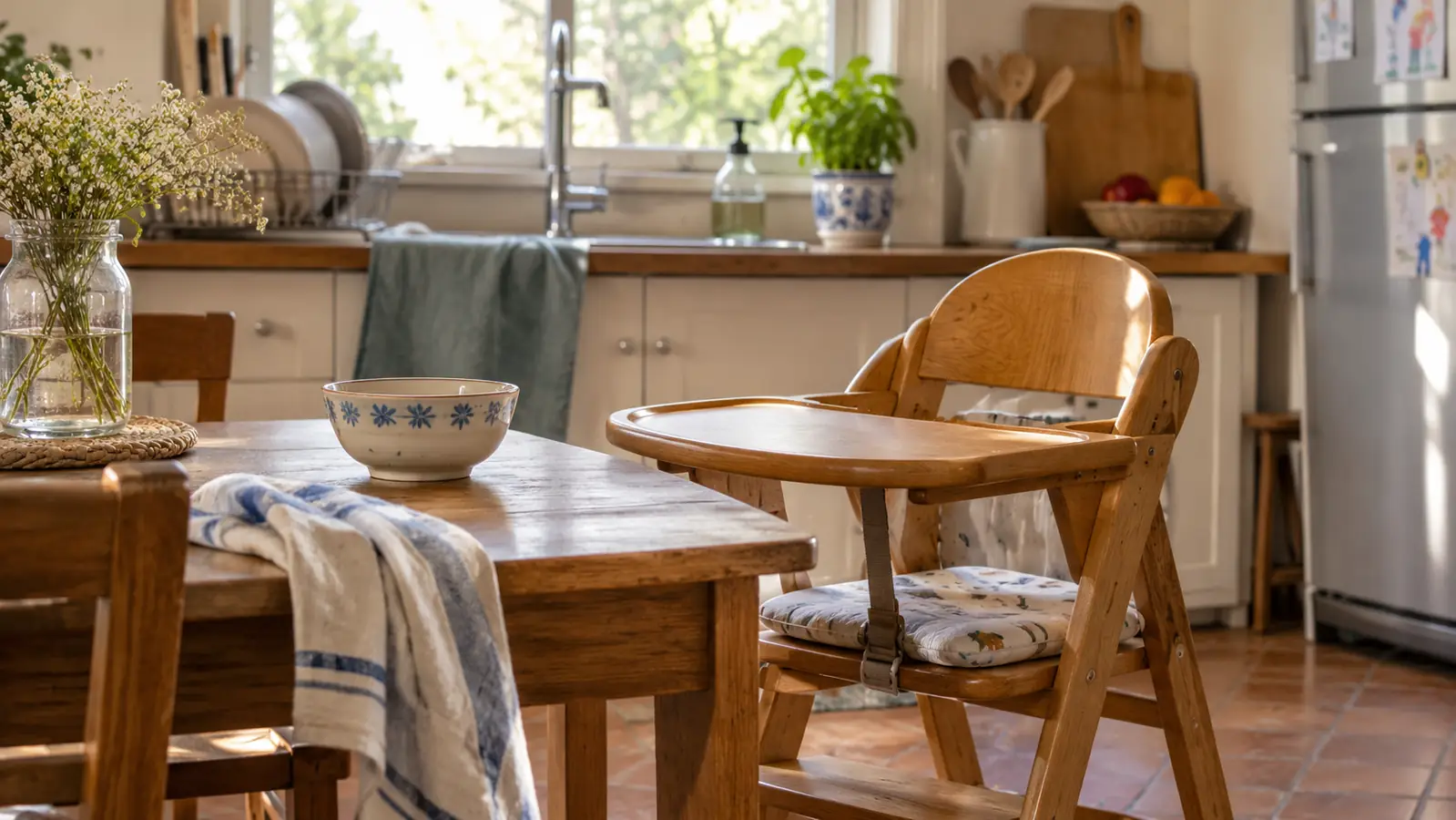
The first week I kept Theo at my house, I cleaned his high chair four times in one afternoon and still found dried oatmeal packed behind the buckle at bedtime. I raised two children of my own in the 1990s, and back then I owned a vinyl chair with a cloth strap that I carried out to the back yard and hosed down on Saturdays. That chair is long gone, the guidance has changed, and I started over the way any grandmother does, one mess at a time, until I had a routine that takes about three minutes and does not require a hose.
The chair I keep at my house is a Graco Slim Snacker. I chose it because it folds with one hand and stands up on its own when it is closed, which matters in a single-story Jacksonville house where the kitchen doubles as the hallway to the back door. But the reason it has stayed in the middle of everything is smaller than that. The seat pad is wipeable, so the part that gets the dirtiest is also the part I can clean with a cloth instead of a washing machine. Graco built this one around the fact that babies are messy, and after four months of weekday lunches I can tell you that is the feature I use every single day, at every single meal.
The one feature I use every single day
The Graco Slim Snacker has a wipeable seat pad, a one-hand, one-second fold, and a storage basket that keeps the bibs and wipes off my counter. It is the chair I keep at my house for Theo, and the reason this routine fits into three minutes.
Amazon Check Today's Price on Amazon →Step 1: Scrape the Seat Before You Touch a Cloth
The mistake I made for the first month was reaching for a wet cloth right away. All that does is smear a banana across a larger area and push the crumbs into the seam where the pad meets the shell, and then you are not cleaning, you are relocating. Scrape first. I keep a small silicone spatula in the drawer next to the sink that never goes back in the cooking drawer, and I use it to lift the bulk of the food off the seat and into a bowl.
The bowl matters more than it sounds. If you scrape onto the floor you have simply moved the job to your knees. If you scrape into a bowl you can carry the whole thing to the trash in one trip with the baby still in the chair watching you. Theo finds this fascinating. He is a few months old now and a spatula is genuinely the most interesting object in the room, which buys me the ninety seconds I need.
Work from the top of the seat down and from the middle out toward the edges, so you are not dragging food back across a clean patch. Anything loose that a dry paper towel will take, take it now. Dry crumbs are a five-second problem. Wet crumbs are a five-minute problem, and they are the ones that set like cement in the corners.
Step 2: Wipe the Pad While It Is Still Wet
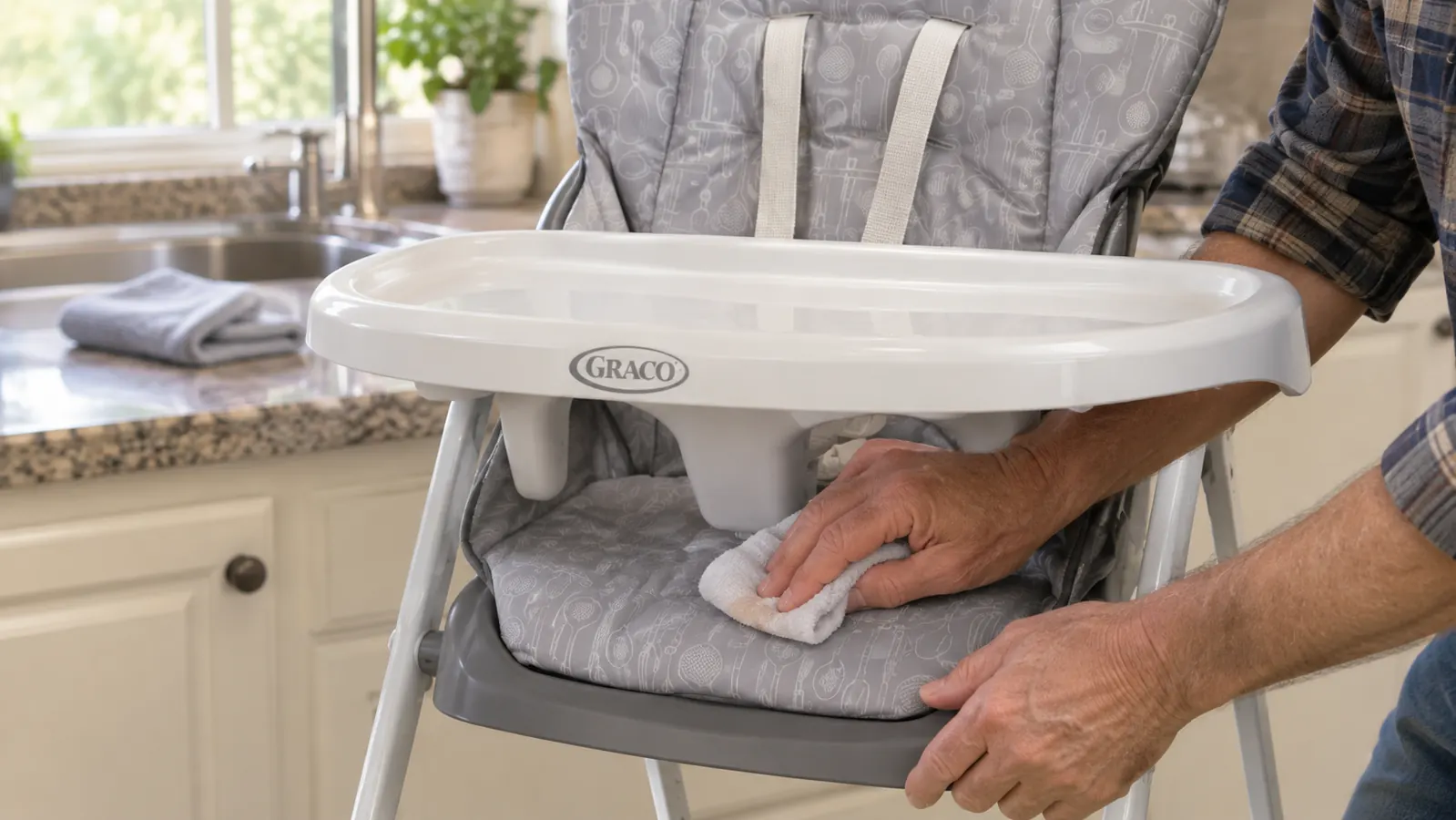
Warm water, one drop of dish soap, and a cloth wrung out until it is damp rather than dripping. The seat pad is polyester and it is built to be wiped, not soaked, so the cloth does the work and the water stays in the cloth. If you flood the seam you will be drying it out for a week and wondering why the chair smells like a gym bag by Thursday.
Wipe the flat of the seat first, then the backrest, then the sides. Turn the cloth to a clean section as you go, because a cloth that is already full of food is a spreading tool, not a cleaning one. If the pad still feels tacky when you run a finger across it, your cloth was too dry. If water is beading on the surface, it was too wet. Somewhere in the middle is a wipe that takes twenty seconds and actually does the job.
Then dry it. This is the step people skip, and it is the step that decides how the chair smells by the end of the week. A second dry cloth pressed flat pulls the moisture out of the texture in about as long as it took to wet it. Keep two cloths on the hook, one damp and one dry, and the whole thing becomes muscle memory by the second week.
Step 3: The Buckle, the Straps and the Crease Nobody Wipes
The buckle is where the real work is. Every meal puts a little food into it and every meal you skip it, that food dries a little harder. Wrap a fingertip in the damp cloth and work around the inside of the buckle, then open and close it a few times while it is still damp so the mechanism clears itself. A buckle that clicks cleanly is also a buckle you can trust, which is not a small thing when you are the one strapping a baby into a chair.
The straps get wiped along their length rather than scrubbed sideways, because sideways just pushes food into the stitching. Run the cloth from the top of the strap to the bottom in one pass, then go back over it with the dry cloth the same way. Check the stitching with your thumb when you are done. If it still feels stiff, it is not clean yet.
Then the crease. Every high chair has one, the line where the seat pad tucks against the shell, and it catches everything that rolls. Run the cloth along it with a fingernail behind the fabric. If something has dried in there, hold the damp cloth against it for ten seconds before you scrub. Soaking beats scrubbing every time, and it does not wear the pad out the way repeated scrubbing does.
Get the pad wiped and the buckle dry and the chair is ninety percent done. In four months I have not had to take it apart once.
Step 4: The Frame, the Floor and the Basket Underneath
Once the seat is done, the frame takes about thirty seconds. A damp cloth down each leg, around the joint where the chair folds, and across the front edge where a baby's hands land after every single bite. Then dry it. A wet joint on anything that folds is the one place I actually worry about over months of use, and drying it costs nothing.
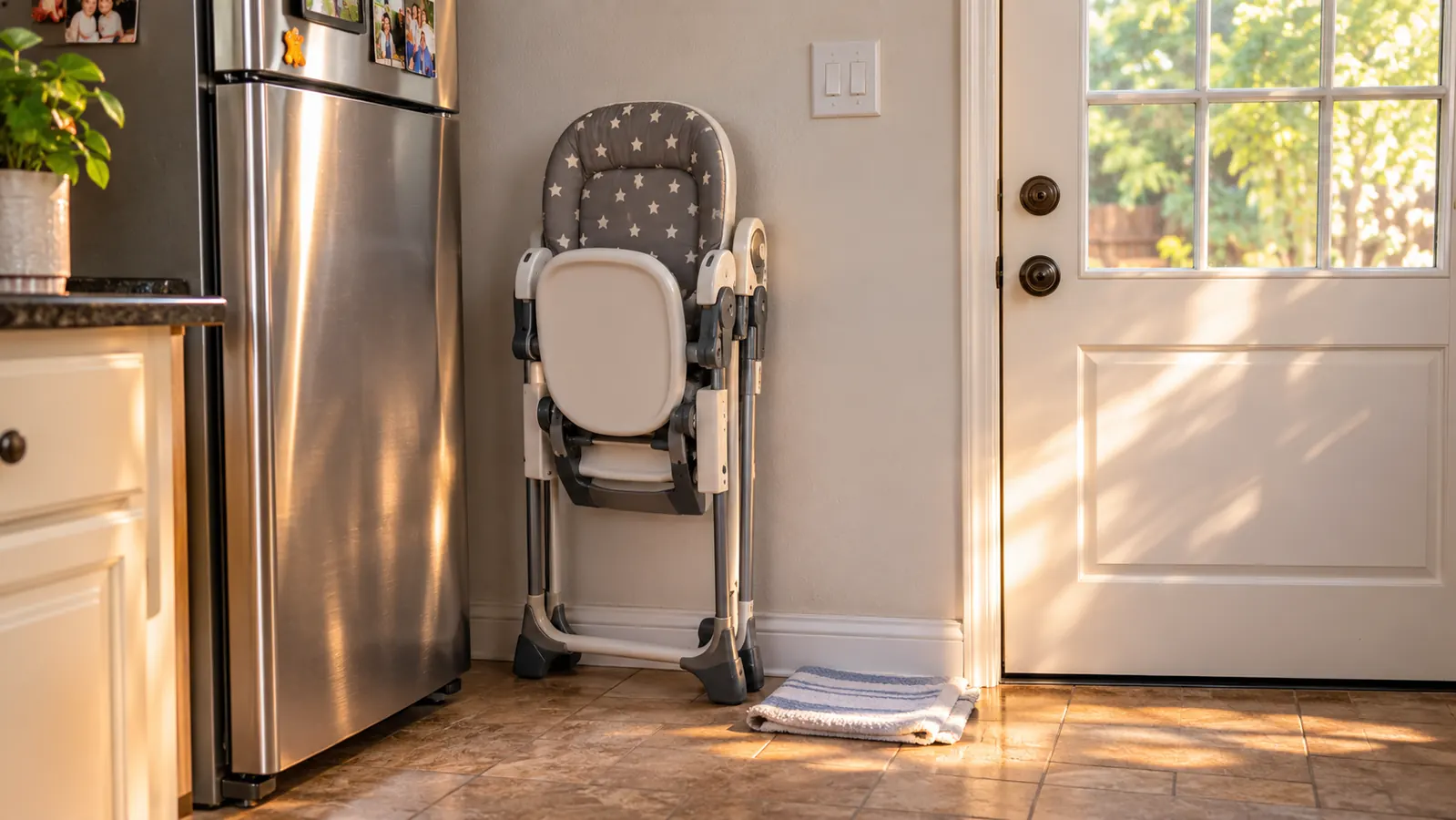
The floor is part of the job whether you like it or not. I keep a folded towel under the chair now, which sounds fussy until you have scraped yogurt out of a tile grout line at nine at night. The towel goes in the wash with the dish towels and a fresh one goes down. On the days I forget, a damp paper towel and one pass with a dustpan handles it before anything sets.
This is also the moment to deal with the storage basket. The Graco has one for bibs and wipes, and it collects crumbs the way a coat pocket collects sand. Tip it out over the trash, wipe the bottom, and put everything back where you can reach it with one hand. That last part is not housekeeping. It is the difference between a calm start to lunch and a search through three drawers with a hungry baby in your arms.
Step 5: Dry It All the Way, Then Fold It and Reset
Do not fold a wet chair. The one-hand fold is the reason I can put this chair away with Theo on my hip, but a damp pad folded against itself overnight is how you get a smell you cannot track down. Give it two minutes with the seat open and the air moving through the kitchen, then fold. Two minutes is one bottle. You have two minutes.
The fold is a one-hand, one-second motion and the chair stands on its own once it is closed. Mine goes against the wall between the refrigerator and the back door. The listed footprint is 11.7 inches deep and 21.4 inches wide, and in a kitchen this size that is the difference between a chair that lives out permanently and a chair I trip over twice a day. It weighs 14.2 pounds, so I can carry it out to the porch by myself when we eat outside in the shade.
Last comes the reset, and it is the step that makes tomorrow easy. Fresh cloth on the hook, bib back in the basket, spatula back in the drawer, towel squared up under the chair. Under a minute, all of it. Doing that at night means the morning does not start with a sink full of cold washcloth and a baby already fussing. I learned that one the hard way in week two.
What Else Helps
Buy a pack of cheap bar mops and keep a dozen of them. Not the good kitchen towels, the thin white ones you do not mind ruining. A cloth you are willing to use on a buckle at seven in the morning is worth more than a beautiful towel you hesitate to get dirty. I keep four on the hook and the rest in the basket under the chair so I am never hunting for one.
A spray bottle of plain water lives on my counter. It is not a cleaner, it is a way to wet a stubborn spot without carrying anything to the sink. Spray, count to ten, wipe. That handles dried cereal, dried puree and most of what ends up on the floor.
And give yourself permission to do the three-minute version on a hard day. A high chair does not need to be spotless. It needs the food off the pad and out of the buckle. The deep clean can wait for Sunday. When I was raising my own two in the 1990s I would have told you a chair needed to be carried outside and hosed once a week. Now I know that a wipe after every meal beats a soak once a week, every time, and it is a great deal easier on your back.
One safety note, because I am a grandmother and I cannot help myself. Clean the buckle properly and check that it clicks every time you fasten it, and never leave a wet cloth or a loose strap where a baby can reach it. The cleaning routine doubles as a daily inspection, and that is a good habit to build while they are small enough to stay put.
Three minutes a meal, or a chair you dread walking past
The Graco Slim Snacker folds with one hand, stands on its own against the wall, and has a seat pad you can wipe down before the baby finishes fussing. It is the chair that made this routine possible in my kitchen, and it is the one I would buy again.
Amazon Check Today's Price on Amazon →