
The first time my daughter handed me a stroller in her driveway and told me to just fold it up, I stood there with the thing half collapsed, one wheel in the air, and no idea what I was doing wrong. I raised two babies in the 1990s. An umbrella stroller then folded one way. You nudged the bar with your foot, the frame scissored shut, and you slung it into the back of the car by a single handle. This one was lighter, it had a canopy and a basket and two cup holders, and it folded on a sequence I had not learned yet.
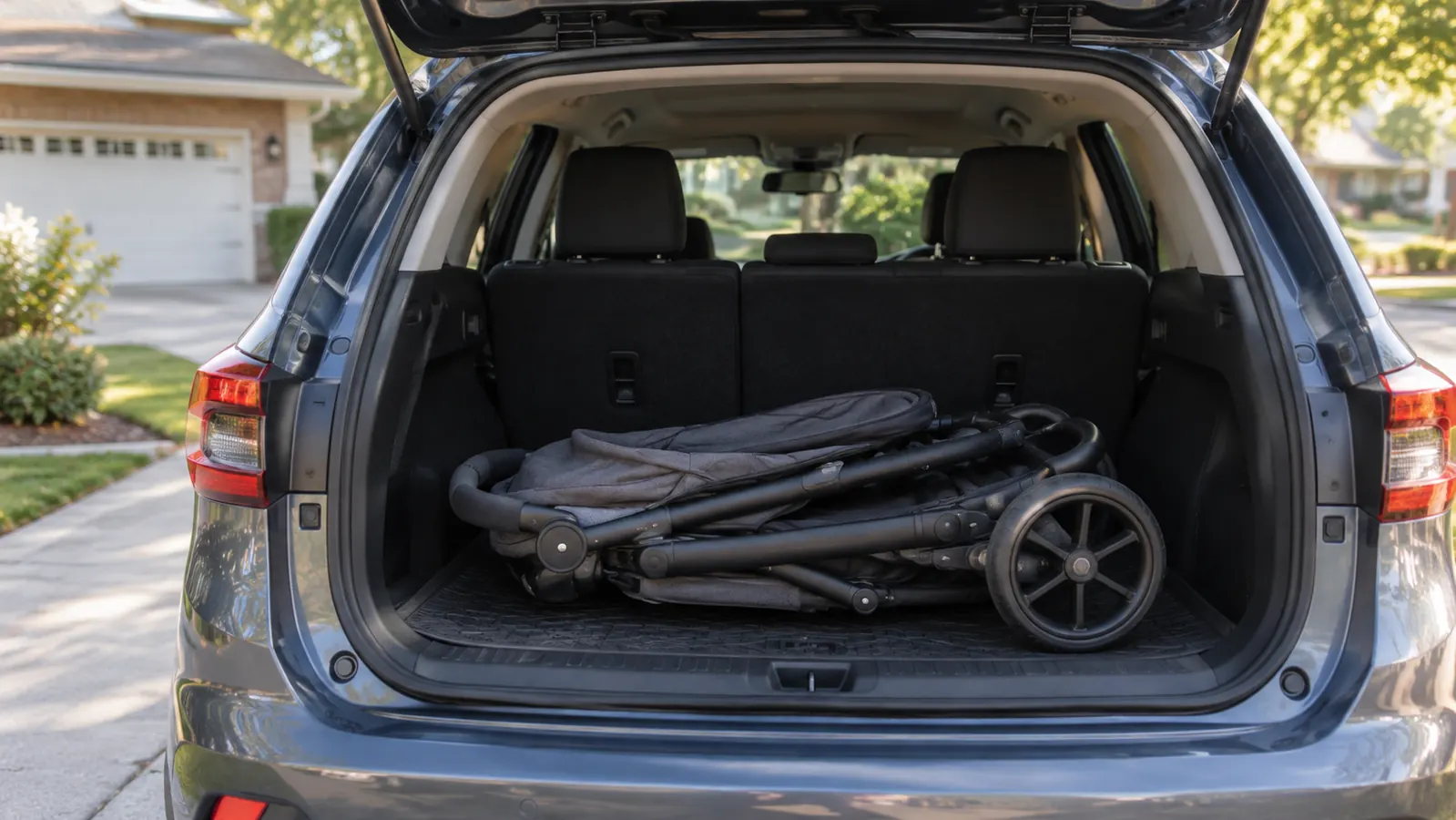
That is the whole trouble, and it is not strength. Folding and loading a lightweight stroller is an order-of-operations problem, and it gets harder in direct proportion to how much you are already carrying. I watch my grandson Theo three weekdays a week at my house in Jacksonville, so a stroller lives in the back of my silver CR-V most of the time. By the second week I had a routine. The stroller I keep is the Ingenuity 3D Mini Convenience Stroller, an umbrella-style stroller that weighs 11 pounds and folds down to 44 by 9.5 by 13 inches. I did not choose it for the fold. I chose it because it was light enough to manage with one hand on the handle and one hand on the baby. The folding came after, and it took about seven days to stop thinking about it.
The stroller that lives in my trunk, folded and flat, three days a week
Eleven pounds, an umbrella fold, a five-point harness and a canopy that comes forward over a sleeping baby. This is the one I load and unload by myself at 62.
Amazon See the Ingenuity 3D Mini on Amazon →Step 1: Make room in the trunk before you carry anything out
This sounds like the step that does not matter. It is the step that decides whether the rest goes smoothly. The folded frame is 44 inches long and about 13 inches wide, so it wants a long, flat footprint rather than a tall one. In the back of the CR-V that means the space closest to the hatch, laid front to back. If there is a case of water, a bag of potting soil from the garden center, or the umbrella I keep forgetting to take inside, it has to move first.
I put a rubber cargo mat down. It keeps the folded frame from sliding when I take a turn faster than I meant to, and it keeps the fabric off whatever grit is on the floor. If you do not have a mat, an old bath towel works just as well and washes easier.
Measure the opening before you trust it, too. I did not think to do this until a Tuesday in May when I had a full load of groceries already bagged and a stroller that would not go in the way I wanted. The cargo opening on my CR-V is wider than the 13-inch folded frame by a comfortable margin, but the height with the hatch open is the number people forget. I knelt on the bumper with a tape measure and wrote the three numbers on a sticky note that is still on the inside of my garage door: 44 long, 13 wide, 9.5 deep. Now I know before I buy anything at the garden center whether it will ride home in the trunk or on the back seat.
I would also pick your moment. Fold and load once at home, in your own driveway, with someone else holding the baby. Learning the fold in a crowded lot with a car seat heating up in the sun is how people get frustrated enough to leave the stroller in the garage and carry the baby instead. Ten quiet minutes in your own driveway saves an hour of aggravation later.
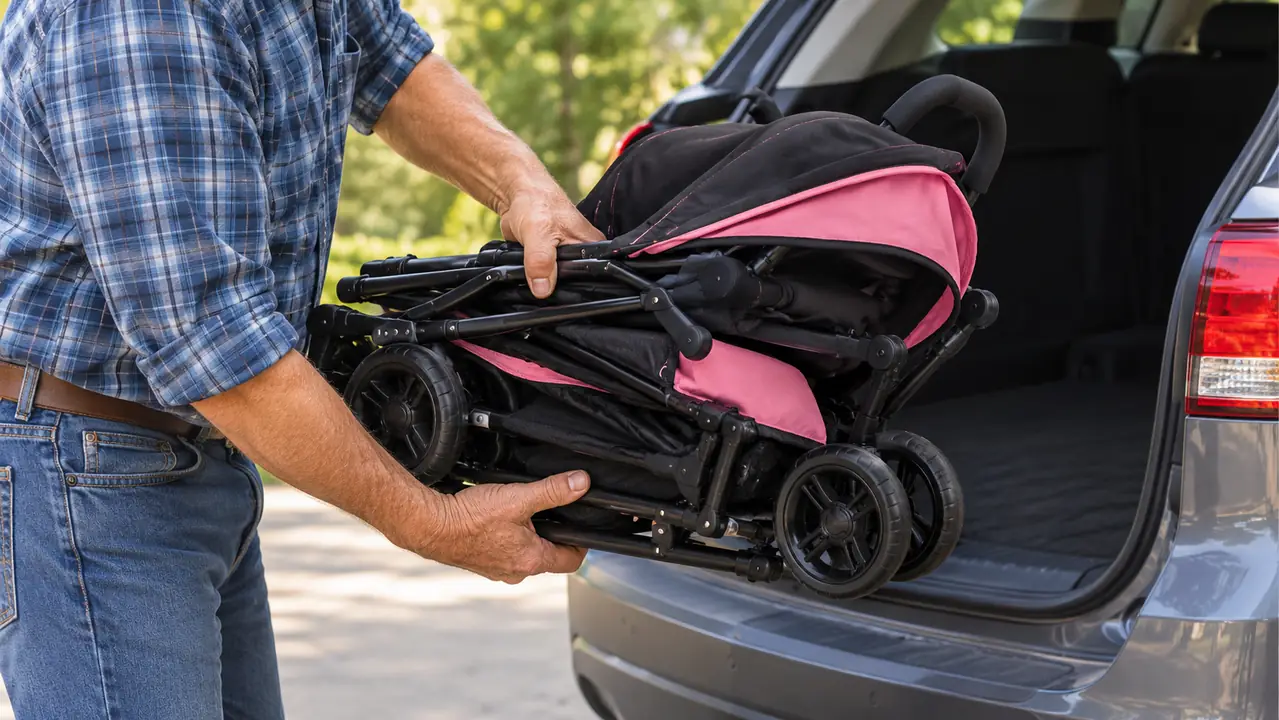
Step 2: Fold it in the same order every single time
The mistake I made the first month was folding it a different way depending on what I happened to be in a hurry about. Do it in one order and the fold becomes muscle memory, which is exactly what you want when a baby is fussing and you have four minutes.
My order. Canopy back first, so it is not standing up while the frame comes together. Then the seat back up to its most upright position, because this stroller has a multi-position recline and a reclined seat makes a bulkier bundle. Then I lay the padded five-point harness straps flat across the seat instead of letting them dangle, so nothing gets pinched in the hinge.
The first week I skipped the harness step twice and paid for it both times. A strap looped itself around the frame joint and I had to open the stroller back up in a parking lot to free it, with a baby carrier balanced on the hood of the car. The second time it happened I was at the back porch of my own house, which was only embarrassing. The first time was in a Publix lot in the middle of the afternoon and it taught me more than any instruction sheet could.
Then the fold itself, and here I will say the honest thing. Follow the manual that came with your stroller, because the release differs from model to model and I am not going to describe a lever I cannot see from where I am sitting. What I can give you is the check afterward. I lift the folded frame a few inches off the ground. If it stays shut and compact in my hand, it is folded. If it sags open at the bottom, I set it down and start over rather than forcing it.
Step 3: Lift it with two hands, close to your body
Eleven pounds is nothing in a gym. Eleven pounds is a different matter when it is a long awkward bundle and you are twisting to swing it over a bumper. I am 62 and my back files a complaint whenever I get careless about this.
Both hands. One on the frame near the middle, one under the folded seat. Keep it against your body and turn with your feet rather than your waist. Do not carry it by the canopy. The canopy is fabric with a flip-out sun visor, not a handle, and it will not thank you for the promotion.
The reach matters as much as the lift. I am five foot four, and the cargo floor of an SUV sits lower than a kitchen counter but farther away than it looks from the side. What fixed it for me was stepping in close enough that the bumper touched my legs before I bent, then bending at the knees and sliding the frame in rather than swinging it up and over. The day I stopped trying to reach across the bumper was the day my lower back stopped aching on Wednesday nights. It also stopped me from setting the folded frame down on the paint, which I had done twice and regretted both times.
And if you are holding the baby, put the baby down first. The car seat goes on the ground beside you, or the baby goes in a carrier on your chest, and then the stroller gets lifted. I have done it the other way exactly once and I do not recommend it to anyone.
Eleven pounds is nothing in a gym and a different thing entirely at the back of a parking lot with a baby on your hip.
Step 4: Lay it long and low, then stop it from sliding
The folded stroller is 44 inches long, 9.5 inches deep and 13 inches wide. That is a shape that wants to lie down flat, long side running in and out of the cargo area. Standing it upright against the seat back looks tidier and works worse, because the first time you brake it tips over onto something.
Wheels either toward the hatch or toward the back seat, whichever leaves the most room for groceries. I put mine with the rear wheels facing the hatch, since those wheels are 5 inches across and there is less chance of the frame rolling around when it is resting on them.
Then put the weight where it belongs. The diaper bag rides on the floor, not on top of the stroller. Nothing heavy goes on the folded frame, and I do not hang a tote off the handle either, because a loaded handle pulls a stroller over backward and it does that with a baby in the seat just as easily as without one. If the back is full, I use the cargo cover or a strap across the frame to stop it shifting, and the storage basket stays empty until we are parked and the stroller is open again.
The sliding problem shows up later than you expect, and it usually shows up at a red light. A folded frame resting on its own rear wheels will creep a couple of inches on a slick cargo floor every time you stop short, and after a month of that mine had worn a pale scuff line across the mat. Two things ended it. The rubber mat underneath gave the wheels something to bite, and I started laying the frame with the handle end against the back of the rear seat so it had a wall to bump into instead of open floor. If your cargo area is bare plastic, a folded moving blanket does the same job for less than the mat.
Step 5: Open it up and lock it out before the baby goes in
Take it out with two hands the same way it went in, set it on level ground, and open it away from your body so nothing catches a finger. The frame opens until it locks, and it should feel like one solid piece when it does, not like something waiting to fold back up.
Then my test. I press down on the seat with the flat of my hand and give the handle a small shake. If a frame is going to fold under weight, I want it to happen with my hand and not with a baby in the seat. Only after that do I set the recline where I want it, pull the canopy forward against the sun, and lay him in.
Harness last, and harness snug. The Ingenuity has a padded five-point harness with adjustable straps, and the rule has not changed since I was buckling my own two in the 1990s. Snug against the body, no slack you can pinch at the shoulder, chest clip at armpit level. Then the cup holders and the storage pouch get whatever I forgot, which is usually a burp cloth and my phone.
What Else Helps
Park where you can open the hatch all the way. Forty-four inches of stroller plus your own two feet needs room behind the bumper, and a low garage ceiling or a low tree branch will stop the hatch halfway and undo everything you just did. In a crowded lot I aim for the end of a row, or the space with nothing behind it. It is twenty extra steps and it is worth them.
Leave the stroller in the car. The single biggest improvement to my week was quitting the carry-in and carry-out at my own front door. It lives in the CR-V, folded and flat, and it comes out when we walk. The only exception is a hot afternoon, because a closed car gets hotter than people expect, so I open the hatch and let the frame cool before I put a baby anywhere near it.
Keep a small kit in the cargo area next to it. For me that is a folded towel, a spare burp cloth, a water bottle for me, and a light blanket that goes over the seat when we stop for coffee. None of it takes up the room the stroller needs, and all of it means I am not walking back into the house for the third time.
And set up a second set of gear if you are the one watching the baby. That is what I did. Jenna has her stroller at her house and I have mine here, and nobody is transferring a folded frame between two driveways on a weekday morning. If you are a grandparent taking three days a week, the Ingenuity is light enough that having a second one is not the extravagance it sounds like. It is the difference between a walk every day and a walk on the days you remembered.
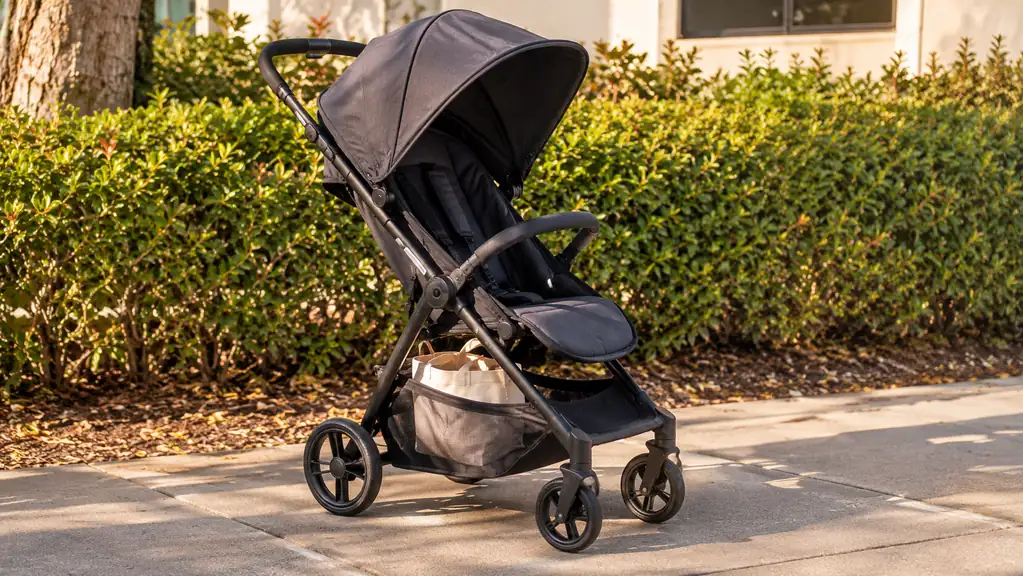
One stroller, folded flat in the trunk, ready for the walk you actually take
Eleven pounds, a compact umbrella fold, a storage basket, two cup holders and a canopy with a flip-out visor. The routine takes a week to learn and then it takes ten seconds.
Amazon See Current Details on Amazon →