
Jenna called me on a Tuesday afternoon in March with a list. Her voice had that tight, tired sound it gets when she has been reading safety manuals at eleven at night. She wanted to know whether my house was safe for Theo. Not in a rude way. In the way of a first-time mother who has just learned that most injuries to babies happen at home, and that a good number of those homes belong to grandparents who raised their own children under different rules.
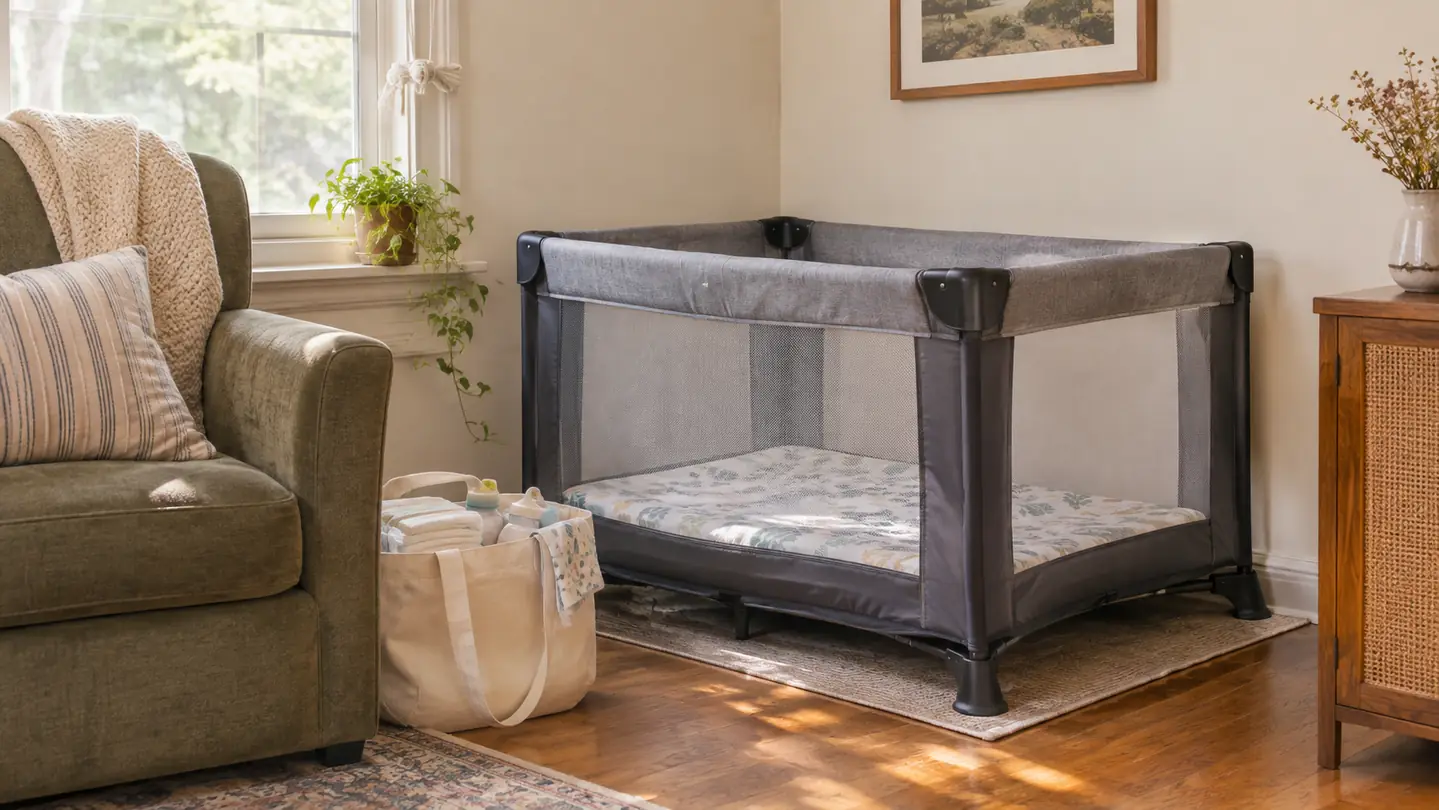
She was right to ask. I raised my two in the 1990s, when we laid babies down on their stomachs with a quilt and a bumper set and believed we were being careful. My house has not changed much since then either. There is a coffee table with square corners, a floor lamp with a cord running across the rug, and a step stool in the kitchen that a crawler would find fascinating. So I picked one corner of the living room, cleared it out completely, and set up a Dream On Me Zodiak portable playard as the fixed safe spot. Three weekdays a week for the last few months, that corner is where Theo lands whenever I need both hands free.
The one piece I built the rest of the corner around
The Dream On Me Zodiak is a folding playard, 16.6 pounds, with a removable mattress pad and a carry bag. It is what I anchored my living room to, and it is the first thing I would buy again if I had to start over.
Amazon Check Today's Price on Amazon →Step 1: Pick one room and one corner, not the whole house
The instinct, when you are setting up for a baby at your own house, is to baby proof everything at once. I started that way and was overwhelmed by lunchtime. The better approach is to choose the room where you actually spend the day and make one corner of it genuinely safe. For me that is the living room, because the kitchen opens onto it and I can see the entire room from the sink.
Pick the corner with three things in mind. It should be away from stairs and away from any door that leads outside. It should be out of the walking path, so nobody trips over a frame while carrying a hot cup of coffee. And it should be visible from wherever you sit or stand most often. A playard in a back bedroom is furniture. A playard you can see from the kitchen is a safe place you will actually use ten times a day.
In my house the winner was the corner between the bookcase and the window, which sounds lovely until you notice the window has a blind cord. I moved that cord up out of reach and wrapped it before anything else went into the corner. The playard came after. It is worth saying plainly: the gear does not make the space safe. That cord was not going to move itself.
Step 2: Measure the footprint and clear a full arm's reach beyond it
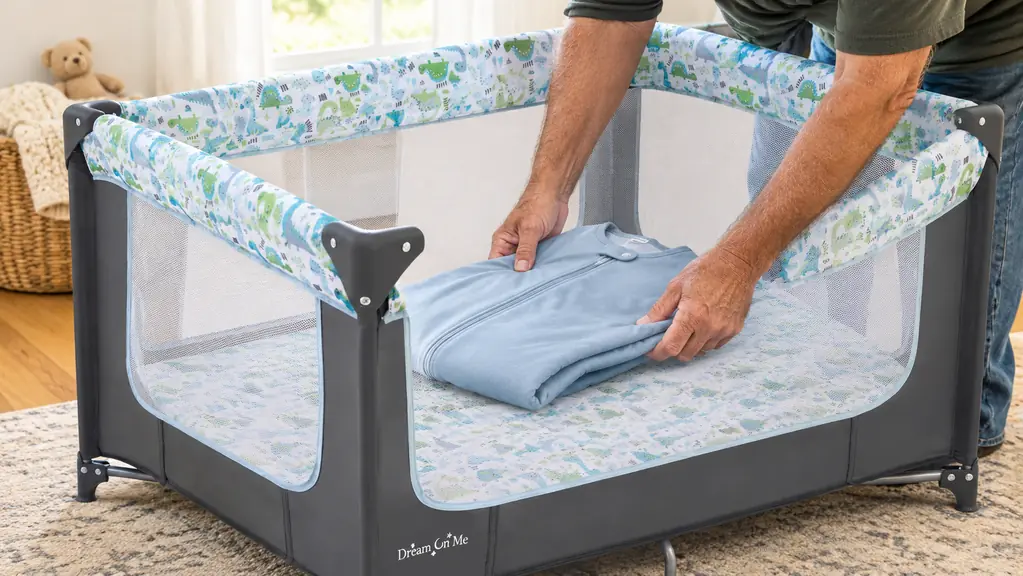
The Dream On Me Zodiak measures 40 inches long, 27.5 inches wide and 25.5 inches tall when it is open. Forty inches is roughly the length of a small coffee table, so it does not need a whole room. It does need a flat surface and it does need breathing room. I laid a tape measure on the floor, marked the four corners with painter's tape, and walked past it for a day before I committed to the spot.
Whatever a baby can reach from inside the frame has to go. For us that meant a side table, a stack of magazines, and the floor lamp. The lamp was the one that mattered. A baby who can reach a cord will pull a cord, and a lamp that tips is a serious hazard. If there is a bookcase or a dresser anywhere near your corner, strap it to the wall. That is not a baby gear purchase. It is a small bracket and fifteen minutes with a drill.
Leave a clear walkway on at least two sides. Mine sits about a foot off the wall so I can step around it and reach in from either end without leaning over the rail. On a hard floor, a thin mat underneath keeps the whole thing from sliding when a baby rocks and makes the corner feel less like it is planted on tile. Do not put anything soft under the playard itself, though. The base needs to sit firm and flat.
Step 3: Set it up once, and check it the way you would check a crib
Open the playard on the floor following the sheet that comes with it, then press the center of the base down until it sits flat. When you push on the frame it should feel rigid, and the floor of it should have no sag in the middle. If either is off, take it apart and start again. It takes about a minute once you have done it twice, and a still-tented base is the one assembly mistake I see people make, usually because nobody pushed the middle down.
The pad that comes with it is removable and about an inch thick, and it sits on the base and stays put. That pad is the play surface and the sleep surface, and it is enough on its own. The fabric is polyester, so it wipes down, which has mattered more than I expected. I keep a spray bottle of plain water and a cloth in the kitchen and wipe the whole thing down on Friday afternoons before Jenna picks Theo up.
The whole playard weighs 16.6 pounds. That is light enough for me to carry from the living room out to the back porch by myself, which I do most mornings in good weather. I set it in the shade, put Theo in with two toys, and sit in the chair beside it with my coffee while the garden gets watered. In the afternoon I carry it back inside. That portability is the reason I chose a playard instead of a second crib, and I would make the same choice again.
Step 4: Get the sleep surface right before you worry about anything else
If a baby is going to sleep in the playard, the rules are the same as at home. On the back. Alone. On a firm, flat surface with nothing else in it. No quilt, no bumper, no pillow, no stuffed animal, no extra mattress laid on top of the pad. This is where my 1990s instincts are the most out of date, and it is where I had to unlearn things I did with my own children in complete good faith.
For warmth, a sleep sack is the answer and a blanket is not. I keep one in the supply tote and put it on Theo before I lay him down. If he falls asleep in the middle of play, I do not add anything to the playard to make him more comfortable. He goes down as he is, on his back, on the pad. The surface stays bare, every time, including the times when it seems like a small thing to toss in a soft toy.
Know the limits before you need them. This playard is for a child up to 35 inches tall or 30 pounds, or until the child starts trying to climb out, whichever comes first. Theo is nowhere near any of those marks yet, but I wrote the numbers on a sticky note inside the cabinet where the wipes live so I do not have to trust my memory. When he reaches one of them, that corner changes. It becomes a floor mat and a gate at the garage steps, and the playard comes down.
Step 5: Build a supply station and a routine, then learn the pack-down
A safe corner is only useful if you can stay in it. I keep a canvas tote beside the chair with diapers, wipes, a changing pad that goes on the floor, a spare outfit, two burp cloths, a pacifier and a couple of toys that get rotated so they stay interesting. Everything I need is within arm's reach, which means I am never leaving a baby alone in a playard while I go hunting for a diaper in another room.
Our routine has not changed in months. Theo arrives, he eats, he has awake time on the floor and in the playard while I get the dishes done, and then he naps in the playard with the monitor pointed at him. In the afternoon we go out to the porch. The structure is not really for his sake. It is for mine. It means I am not re-deciding where to put him down five times before noon.
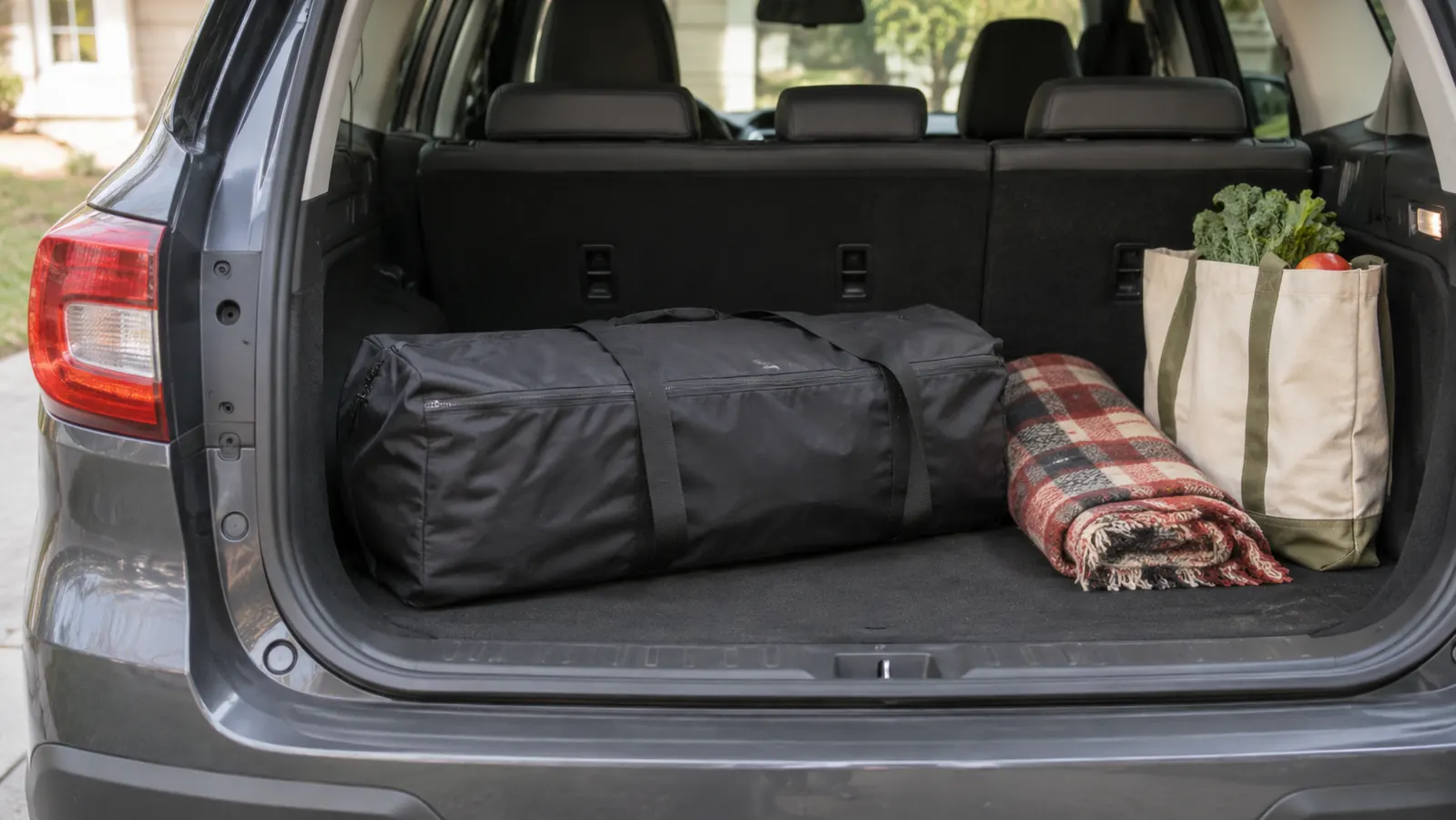
The pack-down takes about as long as the setup did. It folds to 14 by 25.5 inches and goes into a carry bag, and it fits in the back of my CR-V with room to spare. I have taken it to Jenna's house for an overnight and to my sister's for a cookout. If you plan to move it often, practice the fold twice at home first, so you are not learning it in someone else's driveway in the rain.
The playard did not make my house safe for a baby. It made one corner of it safe, and that turned out to be the corner I actually needed.
What Else Helps
Outlet covers in every room Theo might end up in, cabinet locks on the two low cabinets in the kitchen, furniture straps on the bookcase, and a gate at the top of the two steps down to the garage even though this is a single-story house. I wrapped the blind cords in the living room and the bedroom too. None of it is spendy and none of it is interesting to buy, and it all matters more than the toys do.
It also helps to be honest about what a playard is. It is not a crib and it is not a babysitter. It is a place to set a baby down safely for a few minutes while you do something that needs two hands. I looked hard at the Graco Pack 'n Play before I bought, and the deciding factors for me were the 16.6 pound weight and how small this one folds, not the feature list. Whatever you choose, set it up properly, check the frame, keep the sleep surface bare, and put the cords away before the playard goes in the corner.
If you are setting up a corner this weekend, start here
The Dream On Me Zodiak is 40 by 27.5 by 25.5 inches open, 16.6 pounds, and it folds into a bag that fits behind the seat of a small SUV. Clear the corner and anchor the furniture first. This is the piece that goes in last.
Amazon Check Today's Price on Amazon →