

Three mornings a week my daughter Jenna hands me my grandson at the front door, kisses him, and drives off to work. For the next eight hours, everything I do has to happen with one hand free or not at all. That is the whole reason I own a baby carrier, and it is the reason I have opinions about one. I ordered the Infantino Flip 4-in-1 in my first month as the weekday sitter, mostly because it was the carrier the other grandmothers at the park kept recommending, and I have used it three days a week ever since. It hangs on a hook by my back door and it comes down before I have finished my coffee.
I raised two children of my own in the 1990s, when a carrier meant a framed backpack with metal bars and buckles that pinched. Gear has changed a great deal since then, and most of the changes are for the better. What follows is not a technical breakdown. It is what months of ordinary weekday use looks like from the person actually holding the baby while she unloads the dishwasher, including the parts that still irritate me.
The Quick Verdict
Four positions, a buckle setup you dial in once and then forget, and a machine-washable body. It earns its place by my back door. The honest caveats are that the back carry takes real practice and the fabric runs warm in a Florida summer.
Amazon Check Today's Price →The carrier I buckle on before I have finished my coffee
Four positions, 8 to 32 pounds, machine washable. Three mornings a week for months, and I would buy it again tomorrow.
Amazon Check Today's Price on Amazon →How I've Used It
Theo was born in early spring. By the time the carrier arrived he was a little past three months and right around thirteen pounds, which put him well inside the 8 to 32 pound range Infantino rates it for. That range deserves one plain sentence. Eight pounds is the floor. A newborn who has not reached eight pounds yet is not supported by this carrier, and since Jenna's boy came home small, we waited the first few weeks. If you are setting up your own house for a brand new baby, know that going in, because nobody at the register will tell you.
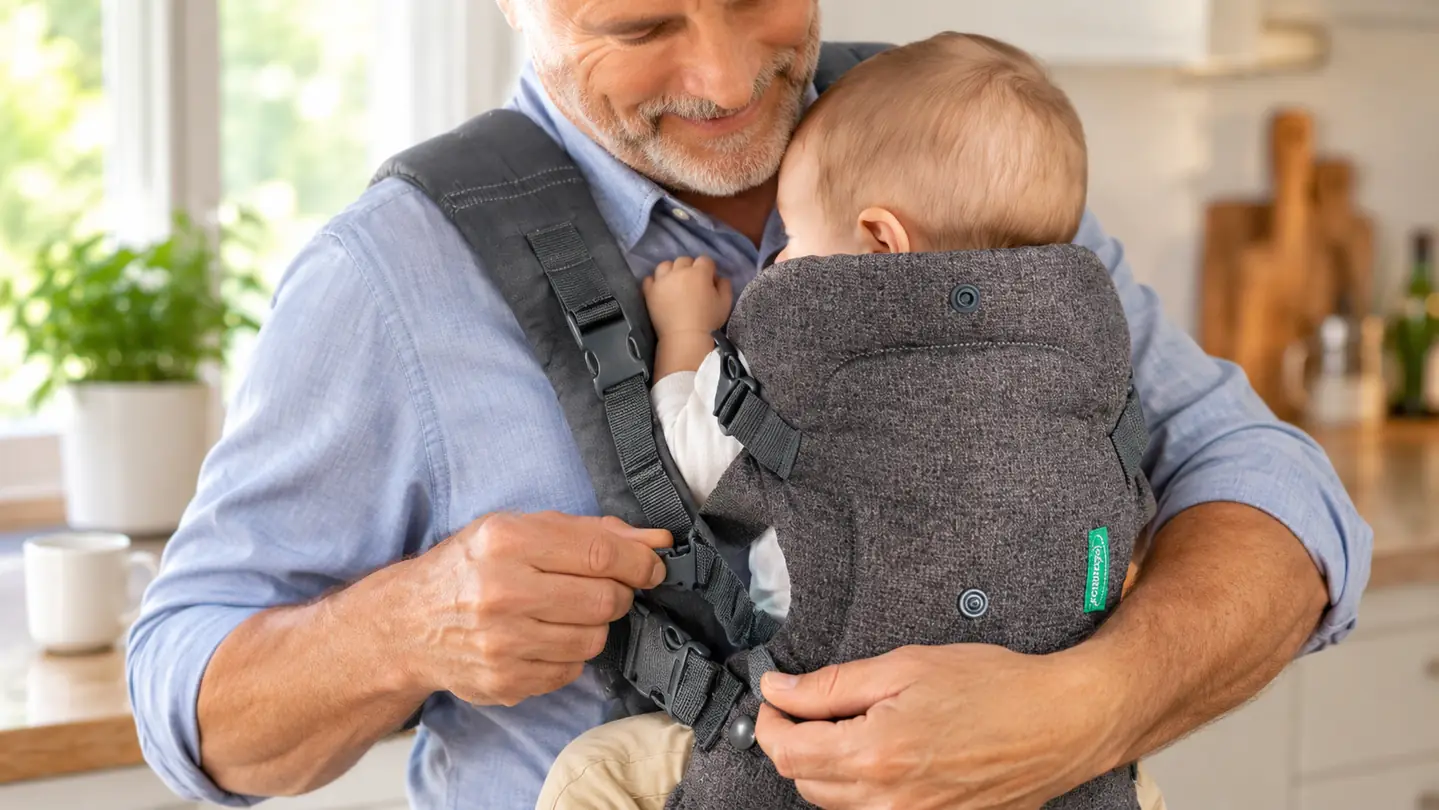
A normal Tuesday goes like this. Jenna drops him at 7:40. I feed him, change him, and by nine he is awake and wants to be up and moving. I put him in facing in with the seat set narrow, buckle it, and we do the rounds. The porch first, because the shade is good there in the morning and the ceiling fan keeps the air moving. Then the garden, where I deadhead the lantana and pull up whatever has come through the mulch where it should not be, which is not a job anyone can do with a baby in one arm. He is usually asleep against my chest by the second lap. The first Tuesday I tried this, back in April, I made it eleven minutes before he started to fuss, and I spent the next ten convinced the carrier was the problem when the truth was that he needed changing.
The grocery run is where it earns its keep. I park the silver CR-V, get him into the carrier in the front seat with the door open, and walk in with both hands free. No cart wrestling, and no car seat balanced on top of a cart, which is something I see every week and something I would not do. A full shop takes me under forty minutes now, roughly half what it took in April with the stroller, the diaper bag and the whole production. The first attempt went badly. I tried to put him in at the open trunk because that looked like the sensible flat surface, and I spent a minute and a half fighting the straps with the hatch propped over my head. In the front seat, with the door open and the cushion at hip height, it is a thirty second job, and I have done it in a downpour without either of us getting soaked.
There is also a fifth use nobody puts on the box, which is the fussy hour between four and five in the afternoon when he has decided he is done with the swing, done with the mat, and done with being put down. That is the hour the carrier comes off the hook by the door. He settles in about four minutes. It is not a fix for everything, but it is a fix for that.
I should say what I used before this, because it explains why a buckle carrier stayed on my hook. Jenna lent me a long stretchy wrap for the first month, the kind you tie yourself, and I wanted to like it. It was soft and it held him beautifully. It also took me three tries to get the tension right the first morning, and the one time I tied it too loose I spent the whole walk with one hand under him, which rather defeats the purpose of a carrier. I am sixty-two and I do not bend the way I did in 1993. The Infantino takes one buckle and one pull. That is the entire reason it stayed and the wrap went back in the hall closet.
What the Four Positions Actually Mean
Infantino lists four carrying orientations: facing in with a narrow seat, facing in with a wide seat, facing out, and back carry. The names are clearer once you are holding the baby. Facing in with the narrow seat is the small infant setting, chest to chest, legs tucked close. Facing in with the wide seat is the same carry after the baby grows, with the seat widened so the legs spread into a supported position instead of dangling straight down.
Facing out is the one that gets grandparents excited, and it is the one I would slow down on. It is lovely for about fifteen minutes at the farmers market, because the baby can see everyone and everyone can see the baby. It is also a great deal of input for a small nervous system. Current guidance is to use it only once head and neck control are solid, and only for short stretches. We tried it on the first Saturday in June, and he was delighted right up until a steel drum player started up about twenty feet away. Then the noise and the crowd got to him and he began to grizzle, and I turned him back in against my chest and he settled inside a minute. That is the pattern. Short and sweet, then back in.
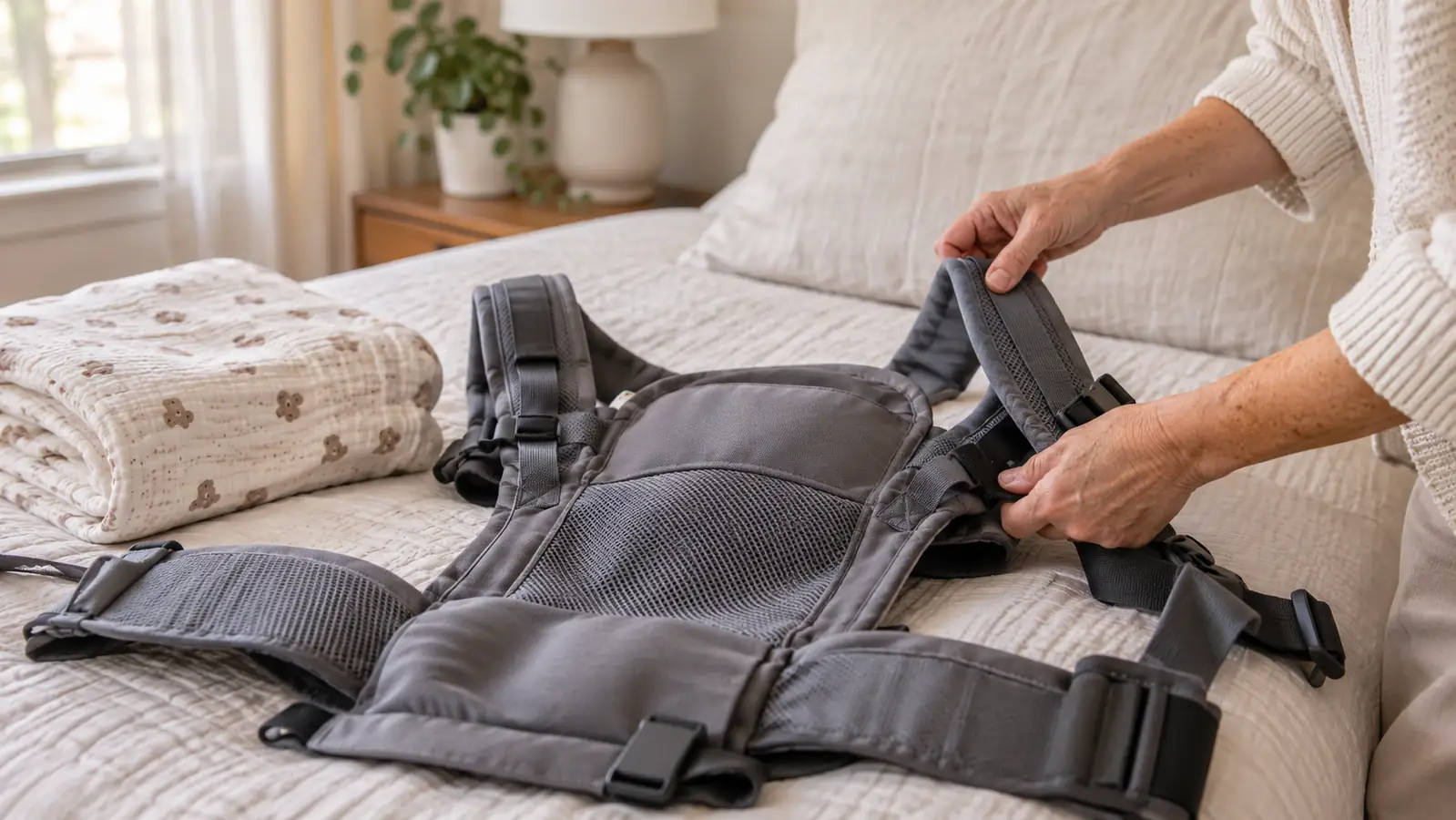
Back carry is the long game. It is what you move to when the baby is heavier and you need your chest clear for real work, and it is the position that will still fit him near 32 pounds. I did not touch it until he was steady and I had read the manual twice. I practiced over the bed, with my husband standing by the first few times, which is exactly how I would tell anyone else to start.
Putting It On Without Help
The closure is a buckle, the straps adjust, and the body is 80 percent polyester and 20 percent cotton. None of that tells you how the first two weeks go. The first two weeks were clumsy. I loosened everything, fought with the straps, got him in crooked, took him out, and started over. The fix was to spend one evening setting the straps to my own body with no baby in it, then leaving them alone. After that it was a clip and one pull to snug.
I want to be specific about that evening, because it is the whole trick. I put the carrier on over a t-shirt with nothing in it, stood in front of the hall mirror, and worked the shoulder straps down until each one sat on the meat of my shoulder instead of my neck. Then I slid two fingers under the strap at my back, pulled the slack through, and looked at where the buckle landed. It took me nineteen minutes the first time. It has taken me zero minutes every morning since, because I have not touched it. The one thing I do change is the shoulder strap length, and only when my husband has used it last.
The check I do every single time, out loud, because my daughter trained me: is he high enough that I can kiss the top of his head without leaning, is his chin clear of his chest, is his face visible and uncovered, and can I slide two fingers under the strap at his back. If any answer is no, I start over. Nobody told me any of that in the 1990s. It is the single biggest change in baby gear since I raised my own, and it matters more than any feature on this page.
Snugging is where the adjustable straps earn their place. A carrier that is too loose lets the baby slump, and a slumped baby is a breathing risk, so the final pull is not optional. Once the straps are set to you, that pull takes one hand and about two seconds. On a wriggling morning it takes three, because he has learned to push his feet against my stomach while I am doing it.
Months Later: How It Has Held Up
This is the part you only learn by living with something. It has been through the washing machine more times than I can count, on the cycle the care instructions call for, then hung to dry over the tub. Polyester and cotton take a wash cycle well. No seam has let go, no buckle has gone sticky or stiff, and the strap adjustment has not crept, which is the failure I half expected after the first month. I checked the stitching at the shoulder joints in July, holding the whole thing up to the porch light, because that is where a cheap carrier gives out first. It looked the way it looked in April.
He is heavier now than he was in April, and the wide seat setting is what we use. Widening it changed the carry in a way I did not expect. The weight moved off my shoulders and down into my hips, and an hour at the garden center stopped being a chore. If you take one thing from this review, take that. Check the seat setting as the baby grows, because leaving it narrow too long is what makes a carrier feel like it is pulling at your neck, and you will blame the straps when the seat is the real culprit.
Two adults share this one carrier at my house. My husband is five inches taller than I am and the straps adjust far enough that neither of us is fighting the other's settings, though we have learned to reset the shoulder straps each time we swap. That is a two-minute annoyance, not a defect, and it is the price of one carrier doing the work of two. He uses it mostly for the evening walk, when I have had enough of being climbed on and he has not.
The one wear mark I can find is on the inside of one strap, where the buckle has rubbed against the webbing over and over as I pull it snug. It is a soft fuzz, maybe an inch long, and it has not progressed in two months. I am mentioning it because a review that finds nothing at all after this many washes is not a review you should trust. Nothing is fraying through, and I do not expect it to before he outgrows the thing.
What I Don't Love
The back carry. It is genuinely useful and genuinely awkward to get into alone for the first dozen tries. You are reaching behind your own shoulder blades while a baby who would rather be doing something else waits. I got there, and I am sixty-two with a touchy right shoulder, so most people will get there faster. Just do not expect it to be graceful in week one. My honest count: it took me about eleven attempts spread over three weeks before I stopped needing a spotter, and the thing that finally worked was sitting on the edge of the bed instead of standing at the mirror.
It runs warm. Polyester holds heat, and July in Jacksonville is not a forgiving climate. Twenty minutes in the carrier on an afternoon and both of us are damp, and he gets a red cheek where his face rests against the panel. We moved the long walks to the morning, which solved it, but if you live somewhere hot, plan around that rather than being surprised by it. On the worst afternoons I tucked a thin cotton cloth between him and the carrier, which helped a little and is not something the instructions tell you.
And washing means you are without it for a day. That sounds small until the one day you need it is the day it is hanging over the bathtub. Wash on a Saturday, not a Tuesday. Nobody warned me about that, and I learned it the hard way on a Thursday in June with a fussy baby and nothing to put him in.
What I Liked
- Four positions in one carrier, from 8 pounds up to 32, so it lasted from his first spring through the summer without a second purchase
- The buckle and strap setup holds its setting once you dial it in, which makes a morning put-on a thirty second job
- Machine washable body in polyester and cotton, and it has come through a season of washing with no seam failure
- Widening the seat moves the baby's weight into your hips, which changed an hour-long walk from a chore into nothing
- Two adults of different heights can share it, which is what makes one carrier enough for a whole house
Where It Falls Short
- Back carry is genuinely awkward to get into alone at first, and took me eleven tries over three weeks
- Polyester runs warm, and a Florida afternoon in it leaves both of you damp
- A wash cycle means a day without it, so the timing has to be planned
He is heavier now than he was in April and we use the wide seat. The weight moved off my shoulders and into my hips, and an hour at the garden center stopped being a chore.
Who This Is For
This carrier suits a grandparent or a second household that needs one carrier and does not want to buy a specialty item that lives by the back door. It suits a baby past eight pounds, a parent or sitter willing to spend nineteen minutes setting the straps once, and anyone who wants a single carrier that will still fit at 32 pounds. If you are setting up a second house so your daughter does not have to pack the car every morning, this is the piece of gear I would buy first, ahead of a second swing or a second bouncer, because it is the one that keeps your hands free while you do the ordinary things. It is also a reasonable choice for a first-time parent who wants one carrier to learn on rather than three to compare.
Who Should Skip It
Skip it if your baby is under eight pounds, because it does not support a newborn that small and no amount of adjusting changes that. Skip it if you want something you can put on in the dark without thinking about strap length, because two adults sharing one means resetting it. Skip it if you have a long, hot summer and plan to be outdoors for hours at a stretch, unless you are willing to move the walks to the morning. And skip it if you need the back carry working on day one, because that one takes patience and there is no version of it that is instant.
One carrier, four positions, and a free hand for the coffee
It has hung by my back door since April and it comes down three mornings a week. If you are setting up a second house for a grandbaby, this is where I would start.
Amazon Check Today's Price on Amazon →