
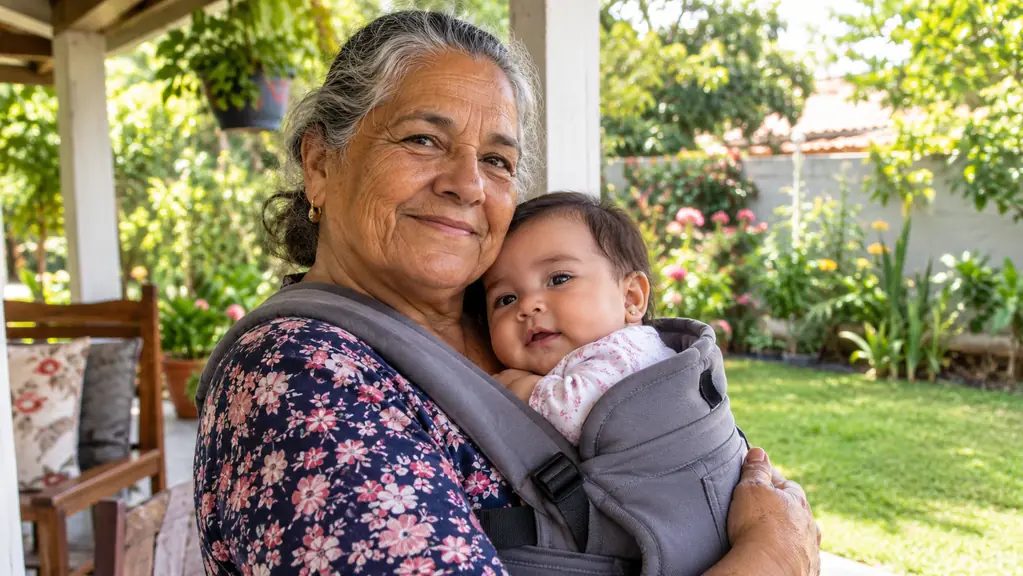
Here is the short answer, because I know you are probably reading this one-handed with a baby on your shoulder. If you want a single carrier that buckles on quickly, adjusts as the baby grows, and is still useful when that baby is walking, the Infantino Flip 4-in-1 is the easier thing to live with. If your baby is brand new and on the small side, or you want something that rolls into a ball and disappears into a diaper bag, a plain stretchy baby wrap does two or three things better than any buckle carrier can. Neither one is the wrong purchase. They are just good at different weeks of the same baby.
My name is Donna Szymanski. I raised two children of my own in the 1990s, back when a baby carrier meant a framed backpack with metal bars and a great deal of webbing, and I am now the weekday sitter for my first grandchild. Theo was born in early spring, he is a few months old now, and he is at my house in Jacksonville three days a week while my daughter Jenna works. That means I keep a second set of baby gear here, and that set has included both a wrap and the Infantino Flip. I have used both on the same baby in the same week, which is the only honest way I know to compare two pieces of gear.
| Infantino Flip 4-in-1 | A baby wrap | |
|---|---|---|
| Using it in the first weeks | Rated from 8 lbs, so a smaller newborn needs a steady hand behind the head | Fabric holds a newborn snug from the first days home |
| Getting it on by yourself | Buckle at the waist, settle the baby against your chest, fasten the rest | Tied around your own body first, which is hard to do one-handed |
| Head and neck support | The panel holds its shape, though a newborn still needs a hand behind the head | The fabric hugs the whole body and keeps a newborn close and supported |
| Sharing between two adults | Adjustable straps and a buckle closure, so a taller and a shorter person can both use it | Tied fresh each time, so it fits whoever is putting it on |
| Carrying past the first year | Rated to 32 lbs, and converts to facing out and back carry as the baby grows | Most people find the fabric starts to pull once the baby gets heavy |
| Back carry | One of the four listed positions, with buckles you can check by feel | Possible with a long enough wrap, though it takes a second person the first few tries |
| Tossing it in the diaper bag | Folds into a bundle that takes up real room | Rolls up small and stuffs in beside the diapers |
| Drying after a wash | Machine washable, but the padded layers take a while to dry | Machine washable and thin, so it dries in an afternoon |
| Adjusting as the baby grows | The seat converts from narrow to wide and the straps adjust, so one carrier covers 8 to 32 lbs | You re-tie it looser or tighter, with no marked settings to check |
Where the Infantino Flip Wins
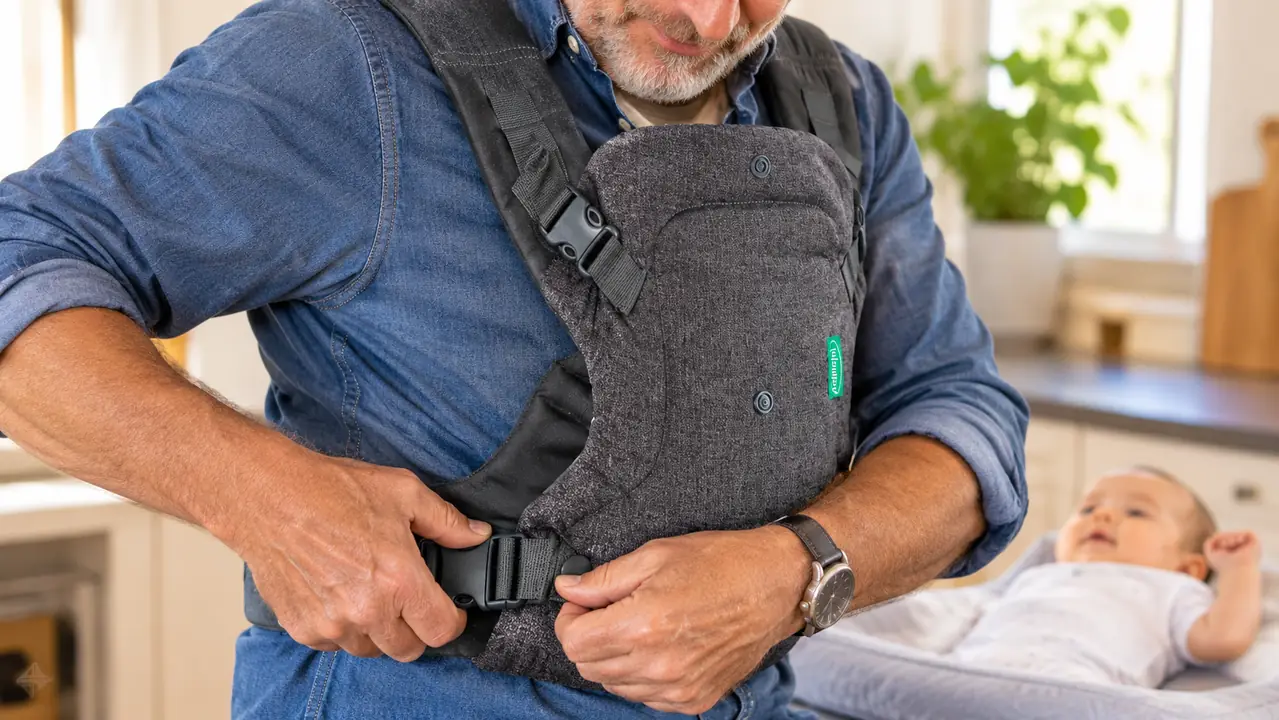
The Flip wins anything that involves getting dressed by yourself in a hurry. You buckle the waist band, lift the baby up against your chest, and fasten the buckles that hold the panel in place. The first time I did it, I had the manual open on the kitchen counter and Theo asleep in the bassinet, and it took me a couple of minutes and one wrong strap. The second time I did it in a parking lot with the back of the CR-V open and a grocery list in my teeth, and it took about thirty seconds. The closure is a buckle and the straps are adjustable, which means there is nothing to tie and nothing to re-tie. That sounds like a small convenience until you are holding a baby who has decided he would rather be held than set down on a cold changing mat.
The other place the Flip wins is the long haul. It is rated from 8 lbs to 32 lbs, and the seat converts as the baby fills out: facing in with the narrow seat when they are small, facing in with the wide seat once the legs chunk up, facing out when they want to see the world, and back carry when they are big enough and want to look over your shoulder while you pull weeds. One piece of gear covered every stage we have hit so far, which is not something I could say about the framed carrier I used in 1994. It is 80 percent polyester and 20 percent cotton and it goes in the washing machine. After one stomach bug, the washable part stops being a footnote and becomes the whole reason you bought it.
Where a Baby Wrap Wins
A wrap wins the first six weeks, and it is not close. The Flip is rated from 8 lbs, and plenty of newborns come home under that, so a wrap may be the only carrier you can use on day three. Beyond the number, a wrap holds a newborn the way your arms do. The fabric spreads across the whole back and around the whole body, the head settles against your chest, and there is no panel edge pressing into a soft little cheek. When Theo was brand new and would only sleep upright, the wrap was what let me eat lunch standing at the counter instead of waiting for him to agree to the bassinet. I did the same thing with my own two in the 1990s, and it is the one piece of baby gear that has not changed for the worse.
It also wins on portability and on noise. A wrap is one long piece of fabric. It rolls into a ball about the size of a sweatshirt sleeve and goes in the bottom of the diaper bag, and it comes out flat and thin in the wash and dries in an afternoon. There are no buckles to click, which sounds like a fussy detail until you have spent twenty minutes getting a baby to sleep in a quiet room and then reach for a carrier with plastic hardware on it. The wrap goes on silent. If you are the person who does the carrying and you have shoulder trouble, the flat spread of the fabric also does something a strap cannot: it puts the weight across your whole back instead of two lines over your shoulders.
The Carrier That Goes On in a Parking Lot With a Grocery List in Your Teeth
The Infantino Flip 4-in-1 buckles at the waist, covers facing in, facing out and back carry, and is rated from 8 lbs to 32 lbs, so it is still the carrier I reach for now that Theo is heavier and nosier. Machine washable, adjustable straps, one piece of gear for the whole first year.
Amazon Check Today's Price on Amazon →A Week of Real Use, Monday to Friday
Monday is errands. Theo goes into the Flip facing in with the narrow seat while I get the stroller out of the back of the CR-V, and then he rides on my chest through the grocery store, because the cart is full of food and the floor is cold and the store is loud. Facing in means he naps. Facing out means he is awake and grabbing at the apples, so I only turn him out for the last ten minutes of the trip, when he has had his nap and wants to look at everything. By the time we reach the car he is asleep against my collarbone, and the buckles come undone with one hand so I can lower him into the car seat without waking him. That handoff is the part I would miss most if I went back to a wrap full time.
Wednesday we stay home. For the first two months I tied the wrap in the kitchen every morning and wore him while I made coffee and sorted laundry, and it was the closest thing to the way I did things the first time around, when nobody owned a structured carrier and we all learned to tie a length of fabric. Around three months, though, the wrap started to feel like a wrestling match. Theo wanted to look around, he did not want his head tucked, and tying a long piece of fabric while a baby squirms on the floor beside you is not something I can do calmly. That is when the Flip took over at home as well, and the wrap moved to the bottom of the diaper bag as backup.
Friday, Marcus does pickup, and this is where an adjustable carrier earns its keep. Marcus is taller than Jenna and I am shorter than both of them, and the straps loosen and tighten enough that all three of us use the same carrier without re-fitting it in between. The wrap works the same way in theory, since it is tied to whoever is wearing it, but it has to be re-tied every single time. When a baby is handed off three times in an afternoon, re-tying gets old fast. I also take Theo out onto the back porch in the shade in the late afternoon, and for that short trip the Flip is simply the thing by the door that takes five seconds to put on.
Rated from 8 lbs to 32 lbs and machine washable, the Flip is the one piece of gear still in daily use at my house now that Theo is a few months old and grabbing at everything.

The Safety Details I Check Every Single Time
Neither carrier goes on without a check, and I check the same things every time, because the guidance has tightened since the 1990s and mostly for good reason. The baby's chin stays off his chest and his face stays clear and visible. Nothing covers his head. The fabric or the panel is snug against him, not loose enough that he can slump sideways. With the Flip, I put two fingers under each strap to make sure the buckles are fully clicked and nothing is twisted. With the wrap, I make sure the fabric is spread across my whole back and every pass is tight before I let go, because a loose wrap lets a newborn curl down into a position you do not want.
The rule that has not changed since my own kids were small is that a carrier is not a car seat and it is not a bed. If Theo falls asleep in either one, he moves to the bassinet. And I read the manual that comes with the carrier, which sounds obvious until you are tired. The Flip manual tells you which seat setting goes with which carry and which weight, and that matters. The narrow seat is for facing in, and the wide seat comes later as the legs fill out. Using the wrong seat setting for the carry you are doing is exactly the kind of quiet error that makes a baby fuss without you ever working out why. Back carry waits until he is big enough and steady enough, and I still practice it over the sofa the first time.
Who Should Buy Which
Buy the Infantino Flip if you are setting up a house where a baby will be several days a week, if you want one carrier that covers the whole first year, or if more than one adult will be doing the carrying. It is the one I would put on a registry, and it is the one that stayed in use at my house after I had borrowed both. It fits from 8 lbs to 32 lbs, it does facing in with the narrow seat, facing in with the wide seat, facing out, and back carry, and the buckle closure means you can put it on in a parking lot without an audience. It is also the carrier I would hand to a grandparent, because the learning curve is one afternoon, not one week.
Buy a wrap, or start with a wrap, if your baby is small or came early, if you want something for the first six to eight weeks while you work out what you actually like, or if the person doing most of the carrying needs the weight spread flat rather than hung from two straps. A wrap is also the right choice if you mostly want to wear a newborn around the house with no hardware at all, and if quiet matters to you at nap time. Plenty of parents end up with both, and I do not think that is wasteful. The wrap does the newborn weeks and the Flip does everything after, and between them you stop guessing.
The One Still Buckled On at My Kitchen Sink Three Months In
If you are only buying one carrier, buy the one that keeps working after the newborn phase. The Infantino Flip covers facing in, facing out and back carry from 8 lbs to 32 lbs, in an 80 percent polyester and 20 percent cotton blend that goes in the washing machine.
Amazon Check Today's Price on Amazon →